
.png)

Power Sweeping for Wood Burners Explained
If your wood burner has started to feel a bit sluggish, is giving off a stronger smoky smell, or just has not been swept for a while, power sweeping for wood burners may be the right answer. It is one of the most effective ways to clear soot, tar and stubborn deposits from a flue, and for many stove owners it offers a cleaner, more thorough result than a standard manual sweep alone.
That said, not every chimney needs exactly the same approach. The right method depends on the appliance, the type of flue, how the stove is used and what has built up inside. A good sweep should explain what they are doing and why, so you know your chimney is being cleaned properly rather than simply being given a quick once-over.
What power sweeping for wood burners actually means
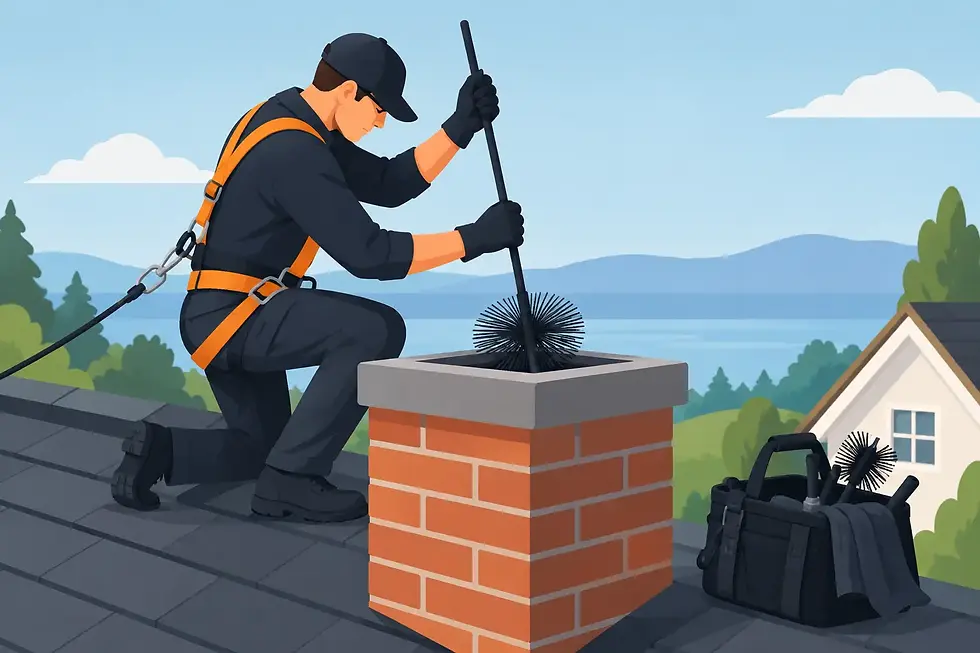
Power sweeping uses specialist rotating equipment with flexible rods and a suitable sweeping head to clean the inside of the flue. The head spins as it works its way through the chimney, helping to break up soot, flaky creosote and other deposits that can cling to the flue liner.
For wood burners, this can be especially useful because modern stoves often run through lined flues with bends, offsets or narrower passages than an open fire chimney. Those areas can hold onto residue more stubbornly, particularly if the stove has been slumbered, fed damp logs or used heavily through the colder months.
In simple terms, power sweeping is not about being rougher. It is about being more precise and more effective where the flue and appliance are suitable for it.
Why wood burners often benefit from power sweeping
A wood burner works very differently from an open fire. It is designed to burn efficiently, but that efficiency depends on good airflow and a clean flue. Once soot and tar begin to build up, performance can drop off. You may notice the fire is harder to light, the glass blackens more quickly, or smoke does not draw up the chimney as cleanly as it should.
Power sweeping can help restore that draw by removing the material that narrows the flue and disrupts the movement of gases. In many cases it also gives a more complete clean around the internal contours of a liner, particularly if the chimney has bends where deposits tend to gather.
This matters for safety as much as convenience. Soot and creosote are not just messy by-products. If enough accumulates, they can increase the risk of a chimney fire. A blocked or restricted flue can also lead to poor combustion and smoke problems inside the room.
How the process usually works
A professional sweep will normally begin by checking the appliance and setting up protective sheets, a high-filtration vacuum and the right access point. Cleanliness matters in any home, especially around a stove in a living room, and there is no reason a sweep should leave soot spread across the hearth or carpet.
From there, the sweeping head and rods are fed into the flue, often through the stove opening or from another suitable access point. The rotating action loosens deposits as the sweep works carefully through the full length of the chimney. The debris is then controlled and removed using proper vacuum equipment.
After cleaning, the sweep may inspect the flue and appliance components, check for signs of damage or blockage, and advise if anything else needs attention. Sometimes the chimney is simply dirty and benefits from a thorough clean. Sometimes the sweep spots glazed tar, a bird issue, a damaged liner or another problem that cleaning alone will not solve.
Is power sweeping always the best option?
Not always, and that is where experience matters.
Power sweeping is excellent for many wood burners, but the method needs to match the chimney. Some flues are better suited to traditional brush and vacuum sweeping, and some jobs benefit from a combination of both. The condition of the liner, the type of deposits and the construction of the chimney all play a part.
For example, if a chimney has heavy glazed creosote, standard sweeping may not fully remove it, but power sweeping may still need to be combined with other remedial steps depending on how severe the build-up is. If the flue is damaged or unstable, cleaning has to be approached carefully. A responsible sweep will not force equipment through a chimney just to tick a box.
So while power sweeping for wood burners is highly effective, the best result comes from choosing the right technique for the job rather than assuming one method suits every flue.
Signs your wood burner flue may need attention
Sometimes homeowners wait until there is an obvious problem, but the early signs are usually there first. If your stove is not performing as it used to, it is worth getting it checked before a small issue becomes a bigger one.
Common signs include a smoky smell in the room, a fire that struggles to draw, soot falling into the stove, blackened stove glass, or a chimney that has not been swept within the recommended interval. If you have recently moved into a property with a wood burner and do not know its maintenance history, arranging a professional sweep is a sensible place to start.
Even if everything seems to be working normally, regular sweeping is still important. Chimneys do not have to be visibly failing to be building up deposits inside.
How often should a wood burner be swept?
It depends on how often you use it and what you burn.
As a general rule, a wood-burning appliance should be swept at least once a year, and more often if it is in heavy use. If your stove is the main source of heat during autumn and winter, or if you burn a lot of wood over the season, more frequent sweeping may be the safer option.
Fuel quality makes a big difference too. Properly seasoned or kiln-dried wood tends to burn more cleanly. Wet or unseasoned logs create more smoke, more residue and more trouble in the flue. Slumbering the stove for long periods can also encourage tar deposits.
A good sweep will give you practical advice based on how you actually use your burner, rather than offering a one-size-fits-all answer.
The difference between a clean chimney and a safe one
People often assume that if a chimney has been swept, it is automatically safe. Very often it will be, but sweeping and safety checks are not exactly the same thing.
A clean flue can still have faults. Liners can deteriorate, joints can fail, birds can nest higher up the stack, and hidden damage can affect how the chimney performs. That is why professional chimney care sometimes includes inspection as well as cleaning, particularly if there are ongoing draught problems, recurring smells or signs that something is not quite right.
Where needed, CCTV surveys can help identify issues that a normal sweep cannot see from the appliance opening alone. This is especially useful if you are trying to diagnose a recurring problem rather than simply keep up with routine maintenance.
Choosing someone to carry out power sweeping
Because you are inviting someone into your home to work on a heating appliance, trust matters just as much as equipment. You want a sweep who turns up when promised, protects your home properly, explains the work clearly and carries out the job with care.
Look for someone who is properly insured, DBS checked and trained, ideally with membership of a recognised trade body such as the National Association of Chimney Sweeps. Those details are not just nice extras. They help show that the person working in your home takes the job seriously.
Just as important is the way they approach the visit. A professional sweep should be friendly, tidy and honest about what your chimney needs. If power sweeping is the right choice, they should explain why. If another method is better, they should say that too.
At Three Counties Sweeps, that straightforward, respectful approach is a big part of the service. Homeowners want the job done properly, but they also want to feel comfortable about who is coming through the door.
A practical choice for many stove owners
For many households, power sweeping is a very good fit for a wood burner. It can deal effectively with everyday soot build-up, help maintain good airflow and support the safe, efficient running of the stove. It is especially useful where lined flues, bends or stubborn deposits make manual cleaning less effective on its own.
Still, the best chimney care is never just about a machine. It is about using the right method, on the right flue, with the right level of care and experience behind it.
If your wood burner is due a sweep, or has started showing signs that all is not well, getting it checked sooner rather than later can save a great deal of mess and worry further down the line. A clean flue helps your stove do its job properly, and that means a warmer, safer and more reliable fire when you need it most.


Comments